|
摘要:采用新型工艺直接冶炼超细的悬浮轻烧粉,得到了微孔增韧型大结晶电熔镁砂,可望提高电熔镁砂抗热震性与韧性;通过引入微量的Cr3+,冶炼出超大结晶电熔镁砂具有结晶尺寸大、晶界杂质少、抗渣侵蚀能力强等优点。工艺的创新对产品的结构带来了改变,进而影响了产品性能。
关键词:大结晶电熔镁砂;微孔增韧;超大结晶
Abstract: The adoption of a novel process for the direct electric smelting of fine suspension caustic calcine magnesia (CCM) powder has resulted in the production of micro pore toughened large crystal fused magnesia (MT-LFM), which has the potential to improve the thermal shock resistance and toughness of fused magnesia. Additionally, the introduction of trace amounts of Cr3+ has led to the development of ultra-large fused magnesia (U-LFM), characterized by large crystal size,
fewer impurities at grain boundaries, and strong resistance to slag corrosion. The innovation in the process has brought changes to the structure of the product, which in turn affects the product performance.
Key words: large crystal fused magnesia; micro pore toughened; ultra-large crystal
1 引言
1 Introduction
1.1 电熔镁砂的重要性
电熔镁砂是一种重要的高温工业原料,主要由氧化镁(MgO)在高温下熔融制成。它具有高熔点、高强度和优异的耐腐蚀性能,广泛应用于耐火材料、冶金工业以及水泥窑和玻璃熔炉等领域。电熔镁砂的使用能够显著提高工业设备的高温稳定性和使用寿命,从而提升工业生产效率和产品质量,是现代高温工业中不可或缺的关键材料之一。
- The importance of fused magnesia
Fused magnesia is an important high-temperature industrial raw material, primarily made by smelting magnesium oxide (MgO) at high temperature. It features a high melting point, high strength, and excellent corrosion resistance, and is widely used in refractories, metallurgical industry, cement kilns, and glass furnaces. The use of fused magnesia can significantly enhance the high-temperature stability and service life of industrial equipment, thereby improving industrial production efficiency and product quality. It is an indispensable key material in modern high-temperature industries.
1.2 传统工艺的局限性
传统电熔镁砂在工艺在生产过程中存在一些痛点,主要体现在以下几个方面:
(1)晶体结构细小:传统电熔镁砂由于快速冷却的工艺特点,导致晶体生长不充分,晶粒细小。这种微观结构使得材料的强度和韧性较低,难以满足某些高温工业对材料性能的高要求。
(2)抗热震性能差:由于晶体结构的不完善和显微裂纹的存在,传统电熔镁砂在经历温度剧烈变化时,容易产生热应力开裂,导致材料的抗热震性能较差。这限制了其在某些苛刻热循环环境中的应用。
(3)化学成分不均匀:传统工艺对原料的纯度和均匀性控制不够精细,可能导致最终产品中化学成分分布不均匀,影响材料的稳定性和一致性。
(4)杂质含量高:传统工艺对杂质的去除效果有限,部分杂质(如SiO2、Fe2O3等)会残留在材料中,影响电熔镁砂的高温性能和耐腐蚀性。
(5)生产能耗高:传统电熔镁砂的生产过程需要高温熔融和快速冷却,能耗较高,且生产效率较低。
(6)环保问题:传统工艺在生产过程中可能产生较多的废气、废渣,对环境造成一定影响。
1.2 The limitations of traditional technology
Traditional fused magnesia production processes have several pain points during manufacturing, primarily reflected in the following aspects:
- Fine crystal structure: Due to the rapid cooling characteristic of traditional fused magnesia production, crystal growth is incomplete, resulting in small grain sizes. This microstructure leads to lower strength and toughness in the material, failing to meet the high-performance requirements of certain high-temperature industrial applications.
- Poor thermal shock resistance: The incomplete crystal structure and presence of microcracks make traditional fused magnesia prone to thermal stress cracking during significant temperature fluctuations. This results in poor thermal shock resistance, limiting its application in harsh thermal cycling environments.
- Inhomogeneous chemical composition: Traditional processes lack precise control over the purity and uniformity of raw materials, potentially causing uneven distribution of chemical components in the final product. This affects the material's stability and consistency.
- High impurity content: Traditional processes have limited effectiveness in removing impurities, and some residues (e.g., SiO₂, Fe₂O₃) remain in the material. These impurities negatively impact the high-temperature performance and corrosion resistance of fused magnesia.
- High energy consumption: The production of traditional fused magnesia requires high-temperature melting and rapid cooling, resulting in high energy consumption and relatively low production efficiency.
-
1.3 新型工艺的突破方向
为解决传统工艺中存在的问题,联合荣大岫岩恒锐镁业潜心研究电熔镁新工艺,致力于研发结晶尺寸大、强度高、抗热震性能强、成分均匀的新产品,近年来已取得较大成果与突破。
1.3 The breakthrough directions of the new technology
To address the issues existing in traditional processes, Xiuyan Hengrui Magnesium Products Co.,Ltd. has been dedicated to researching new fused magnesia processes, and is committed developing new products with large crystal sizes, high strength, excellent thermal shock resistance, and uniform composition. In recent years, significant achievements and breakthroughs have been made in this endeavor.
2 新型电熔镁砂生产工艺与产品改性
2 New production technology of fused magnesia
2.1 直接电熔浮选精矿悬浮轻烧粉与微孔增韧电熔氧化镁的形成
菱镁矿正反浮选工艺大幅度扩展了菱镁矿资源的利用效率,更提高了菱镁矿原料的纯度,特别是二氧化硅含量被大幅度降低。经过浮选的菱镁矿精矿粉再经过悬浮轻烧,市场出现大量的粒度200~300目以下的菱镁矿轻烧细粉。电熔厂家将这种超细轻烧粉压球后再破碎成5~0mm的细颗粒,再用这种细颗粒进行电熔生产大结晶电熔镁砂。由于浮选精矿粉的轻烧粉纯度高熔点高,上述压球后破碎颗粒电熔产品密度较差,因此各厂家都必须在熔炼时掺入部分传统的矿石轻烧粉,后者的硅含量较高,熔点较低,因而有利于致密化。
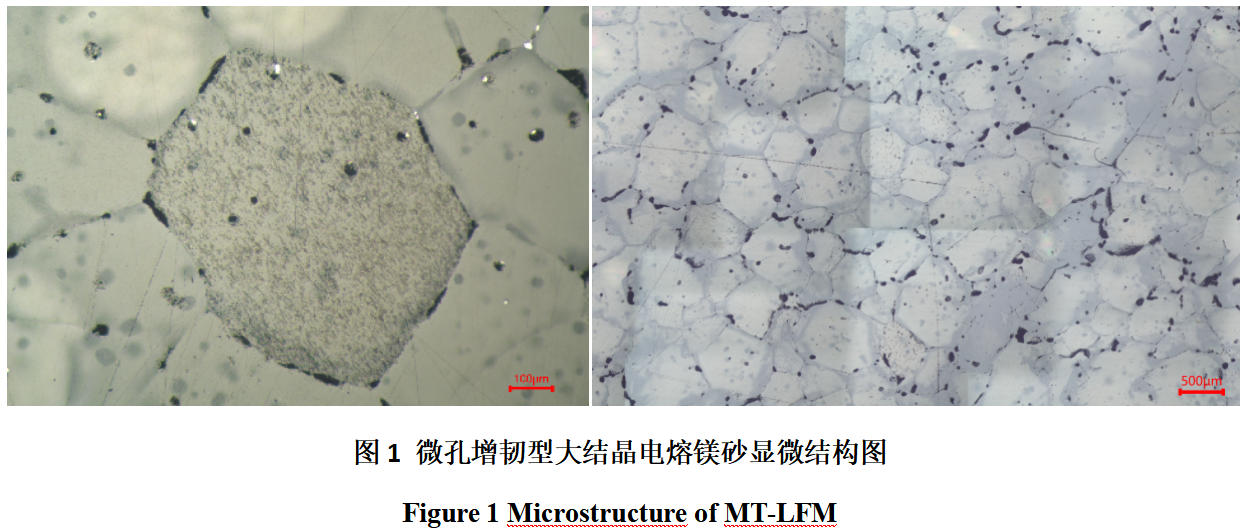
改进后的电熔工艺直接电熔浮选精矿轻烧粉,充分利用了超细轻烧粉的表面能。但全超细粉电熔必然造成熔体内裹挟更多气体需要排出,造成部分气体没来得及排出,直接被封闭在迅速长大的方镁石晶体内。这些气体残留一般都是闭口微孔,尺寸10-50微米。
晶粒内与晶界处的大量封闭气孔能够有效的抵抗方镁石晶体热膨胀系数高引起的热应力,阻止裂纹的扩散,起到晶内闭孔增韧的效果。
2.1 Direct electrofusion process for suspension CCM and the formation of MT-LFM
The direct and reverse flotation process for magnesite has significantly expanded the utilization efficiency of magnesite resources and improved the purity of magnesite raw materials, especially with a substantial reduction in SiO2 content. After flotation, the magnesite concentrate powder undergoes suspended light-burning, resulting in a large market presence of CCM fine powder with particle sizes of 200~300 mesh or finer. Electrofusion manufacturers press this ultra-fine CCM powder into balls, then crush it into fine particles of 5~0 mm, which are subsequently used for electric melting to produce LFM. However, due to the high purity and high melting point of the CCM from the flotation concentrate, the density of the electrofusion products made from the crushed particles after ball pressing is relatively poor. Therefore, manufacturers must add a certain proportion of traditional ore light-burned powder during the melting process, as the latter has higher SiO2 content and a lower melting point, which facilitates densification.
The improved electrofusion process directly uses the flotation concentrate CCM, fully utilizing the surface energy of the ultra-fine light-burned powder. However, full ultra-fine powder electric melting inevitably results in more gases being trapped within the melt that need to be expelled, causing some gases to remain unvented and directly enclosed in the rapidly growing periclase crystals. These residual gas are generally closed pores, with sizes ranging from 10 to 50 micrometers.
A large number of closed pores inside the grains and at the grain boundaries can effectively resist the thermal stress caused by the high thermal expansion coefficient of periclase crystals, thereby preventing crack propagation and achieving the toughening effect of internal closed pores.
-
2.2 三氧化二铬掺杂工艺与超大尺寸结晶
随着耐火材料制品朝着高品质、高端化和长寿节能的方向发展,对耐火原料也提出了更高的要求。电熔镁砂是生产碱性耐火材料的重要原料,耐火材料厂家多追求大结晶尺寸的产品。为此我们研究以掺杂的方法获取大结晶,这种方式会导致晶界处形成第三相,但必须是形成高温相才能保证产品的性能,例如尖晶石类的物质。
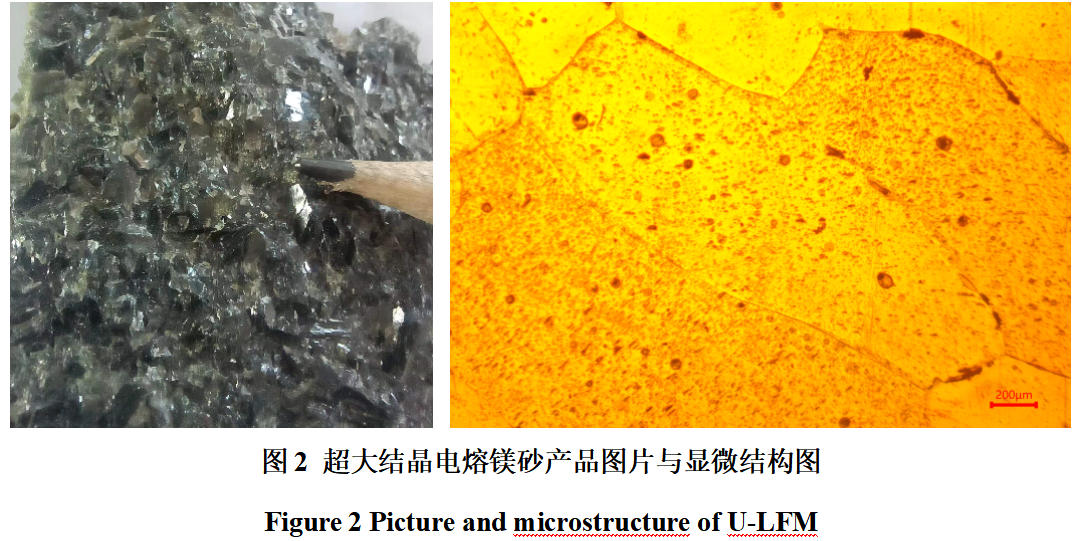
通过实践,以轻烧氧化镁粉为原料,掺杂微量的Cr2O3,经过电熔工艺获得的产品取得了意料之外的效果,形成了超大尺寸结晶的电熔镁砂。产品晶粒尺寸约为普通大结晶镁砂晶粒尺寸的3倍,具有晶粒间直接结合程度高、晶界杂质少的优点,而且晶体韧性大幅度提高,抗侵蚀性能明显优于一般大结晶产品。
-
2.2 Cr2O3 doping process and ultra-large crystal
As refractory products develop towards high quality, high-end, and long-life energy-saving directions, higher requirements are also put forward for refractory raw materials. LFM is an important raw material for producing alkaline refractories, and refractory manufacturers generally pursue products with large crystal sizes. For this reason, we have studied the use of doping methods to obtain large crystals. This approach can lead to the formation of a third phase at the grain boundaries, but it must be a high-temperature phase to ensure the performance of the product, such as spinel-like substances.
Through practice, using CCM powder as the raw material, doping with a trace amount of Cr2O3, and obtaining the product through electric melting has achieved an unexpected effect, resulting in LFM with ultra-large crystal sizes. The grain size of the product is approximately three times that of ordinary LFM, with the advantages of high direct bonding degree between grains, fewer impurities at grain boundaries, and significantly improved toughness of the crystals. Its resistance to corrosion is notably superior to that of general large-crystal products.
-
3 产品性能差异
3 Product performance differences
3.1 微孔增韧型大结晶电熔镁砂结构特性
微孔增韧型大结晶电熔镁砂在方镁石晶体内部均匀分布着直径小于10~50μm的闭口气孔(图1)。与板状刚玉微孔增韧原理相同,大结晶电熔氧化镁的晶内微孔可望明显改善镁砂晶体的韧性,提升材料的抗热震性,缓解热应力集中,减少材料剥落风险,延长镁质耐火材料在温度骤变场景下的使用寿命。
电熔镁砂是一种脆性耐火原料,多年来众多研究者试图在氧化镁晶体中引入孔隙以提高其抗冲击性,但都没有成功。目前,新的微孔增韧型大结晶电熔镁砂可能使这个想法成为现实。98级的大结晶电熔镁砂的实际密度都在3.5~3.52g/cm3及以上。
3.1 Structural characteristics of MT-LFM
In the MT-LFM, uniformly distributed closed pores with diameters less than 10~50μm are present within the periclase crystals (Figure 1). Similar to the micropore toughening principle of tabular alumina, the intracrystalline micropores in LFM can significantly improve the toughness of the magnesia crystals, enhance the material's resistance to thermal shock, mitigate thermal stress concentration, reduce the risk of material spalling, and extend the service life of magnesia-based refractories under conditions of rapid temperature changes.
Periclase or fused magnesia is considered a brittle refractory raw material. Years of research trying to induct pores into the MgO crystal to improve the shock resistance but all failed. Here the new MT-LFM may make the idea come into true. In fact density of grade MT-LFM 98 is always over 3.5~3.52g/cm3.
-
|